Walking After Knee Replacement: A Realistic Week-by-Week Timeline
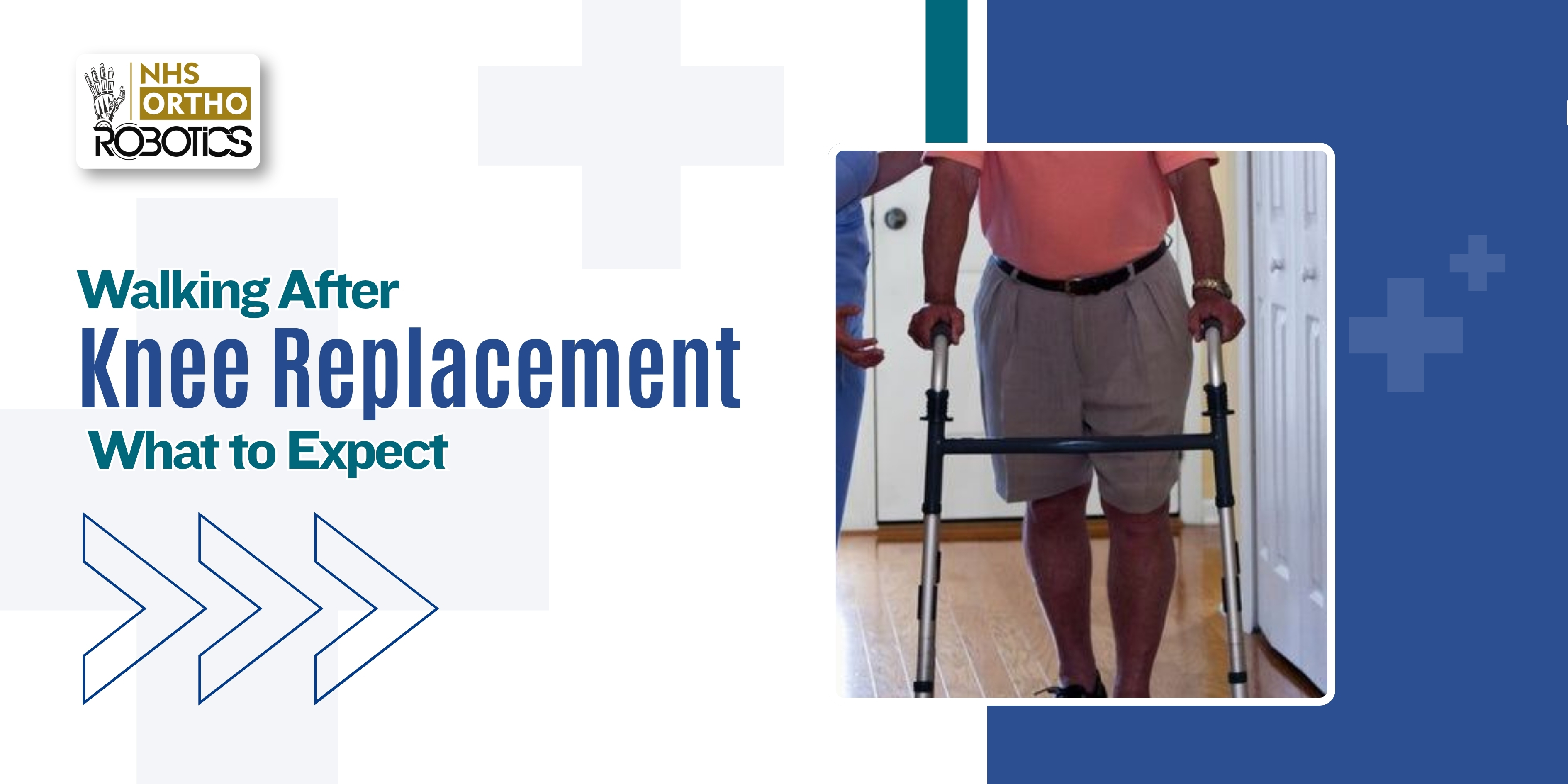
Core Takeaway: Walking after knee surgery is a progressive recovery. Assisted weight-bearing starts on Day 1, transitioning to walking sticks in 2 weeks, unaided walking by 6 weeks, and natural gait within a year.
- Early mobilization (assisted steps on surgery day) prevents stiffness and complications.
- Independence is achieved gradually, transitioning from a walker to a walking stick, then walking unaided.
- Sensible walking serves as productive exercise, rebuilding lost quad strength and gait habits.
- Consistency with physiotherapy and gradual build-up are key to a smooth recovery.
“Doctor, when will I walk again?”
Of all the questions I am asked before a knee replacement, this is the one that carries the most emotion. Because for most patients, walking is not really about walking — it is about independence. It is about getting to the bathroom without help, going to the gurudwara or temple, playing with grandchildren, and not being a burden on the family. When a patient asks when they will walk, they are really asking when they will get their dignity back.
So let me give you an honest, realistic answer. Not the falsely cheerful version, and not the frightening version — the real one, built from 24 years and over 25,000 surgeries.
The headline will surprise you: you will walk far sooner than you think. But walking well — naturally, confidently, without thinking about it — takes patience and steady work. Here is how it actually unfolds.
"I still remember a 72-year-old grandmother from Dharamshala who took her first assisted steps just six hours after her bilateral CORI robotic surgery. Her daughter, sitting in the hospital room, actually broke down in tears of relief. It is a reaction I see almost every week — when family members realize that the scary 'bedridden' phase they feared simply does not exist in modern joint replacement."
Day One — Yes, the Same Day
This is the part that astonishes patients and their families: most people stand and take their first assisted steps on the very day of surgery or the morning after.
I know that sounds hard to believe when you are anticipating major surgery. But getting you up and moving quickly is one of the most important things we do. Early walking — with a walker and with support from our physiotherapy team — reduces stiffness, lowers the risk of clots, improves circulation, and gets your recovery off to the strongest possible start.
These first steps are short and assisted. They are not comfortable. But they are profoundly reassuring — the moment a patient takes those first few steps and realises the knee holds their weight, something shifts. The fear starts to lift.
The First Week — Building Confidence With Support
Through the first week, you will walk with a walker, gradually increasing the distance a little each day. The goal in this period is not speed or distance — it is confidence and consistency. Short, frequent walks are better than occasional long ones.
By the time you go home, you will typically be able to walk to the bathroom and move around your immediate surroundings with your walker. We make sure you can manage this safely before discharge. You will also be taught how to manage a few steps or stairs with support, because most homes require it.
Weeks Two to Four — From Walker to Stick
As the swelling settles and your strength returns, you progress from the walker to a walking stick. There is no fixed day this happens — it depends on your strength, your confidence, and your individual recovery. Some patients move to a stick within two weeks; others take a little longer. Both are perfectly normal.
During these weeks, walking becomes noticeably easier. You will be moving around your home more freely and venturing a little further. The distance you can comfortably cover grows steadily. This is enormously encouraging for patients — the visible, week-on-week progress is proof the surgery is working.
The key in this phase is to keep walking regularly but sensibly. Walking is itself part of your rehabilitation. Combined with your physiotherapy exercises, it rebuilds the muscle strength that the arthritic knee had quietly stolen from you over the years.
Want a clear recovery plan before your surgery?
I’ll walk you through exactly what your recovery will look like, step by step.
WhatsApp Us Call +91 98142 09405 Book AppointmentWeeks Four to Eight — Walking Unaided
For most patients, this is the period where the walking stick gets left behind for indoor walking, and then for outdoor walking too. Again, the exact timing varies from person to person, and there is no prize for rushing.
By around six weeks, many patients are walking independently and comfortably for reasonable distances, and managing stairs with growing confidence. The limp that arthritis caused — and that many patients have carried for years — begins to disappear as strength and gait normalise.
This is often the moment patients tell me their life is changing. They can walk to the local shop. They can manage the steps to the temple. They can go for a gentle stroll in the evening. The independence they feared they had lost forever is returning.
Three Months and Beyond — Walking Without Thinking
By three months, walking is typically comfortable and natural for everyday life. Most patients are walking unaided, climbing stairs, and resuming their normal routines.
From here, the improvement continues more gradually. Your walking endurance keeps building. The last traces of stiffness fade. Somewhere between six months and a year, most patients reach the point they were hoping for all along: they walk without thinking about the knee at all. It simply becomes their knee again.
I always encourage patients to embrace walking as a lifelong habit after recovery. It is the single best exercise for a replaced knee — gentle, sustainable, and exactly what the joint is designed for.
What Slows Walking Recovery Down
A few things can delay the walking timeline, and most are avoidable. Skipping physiotherapy is the biggest one — walking and exercises work together, and neglecting the exercises slows everything. Poor pain control that makes a patient afraid to move, doing too much too soon and aggravating swelling, and underlying issues like poorly controlled diabetes can all play a role. The patients who progress fastest are, almost without exception, the ones who follow the plan consistently and patiently.
A Realistic Word on Variation
I want to be honest: these timelines are typical, not guaranteed. A fit 60-year-old often moves faster than an 80-year-old with other health conditions, and that is completely fine. Comparing your recovery to someone else’s is rarely helpful. What matters is steady progress in your own recovery — and as long as you are moving forward week by week, you are on the right track.
The Bottom Line
You will walk on day one. You will likely move to a stick within a couple of weeks, walk unaided within a couple of months, and walk without thinking about it within the year. That is the realistic arc of recovery for most patients.
The walking you lost to arthritis — slowly, painfully, over years — comes back faster than it left. It takes patience and it takes doing the work. But for the overwhelming majority of my patients, getting back on their feet, independent and free of that grinding pain, is exactly what makes the whole journey worth it.
Correct diagnosis | Clear guidance | Right decision