Knee Resurfacing, FT3D and RoboLens — What Patients Should Actually Know
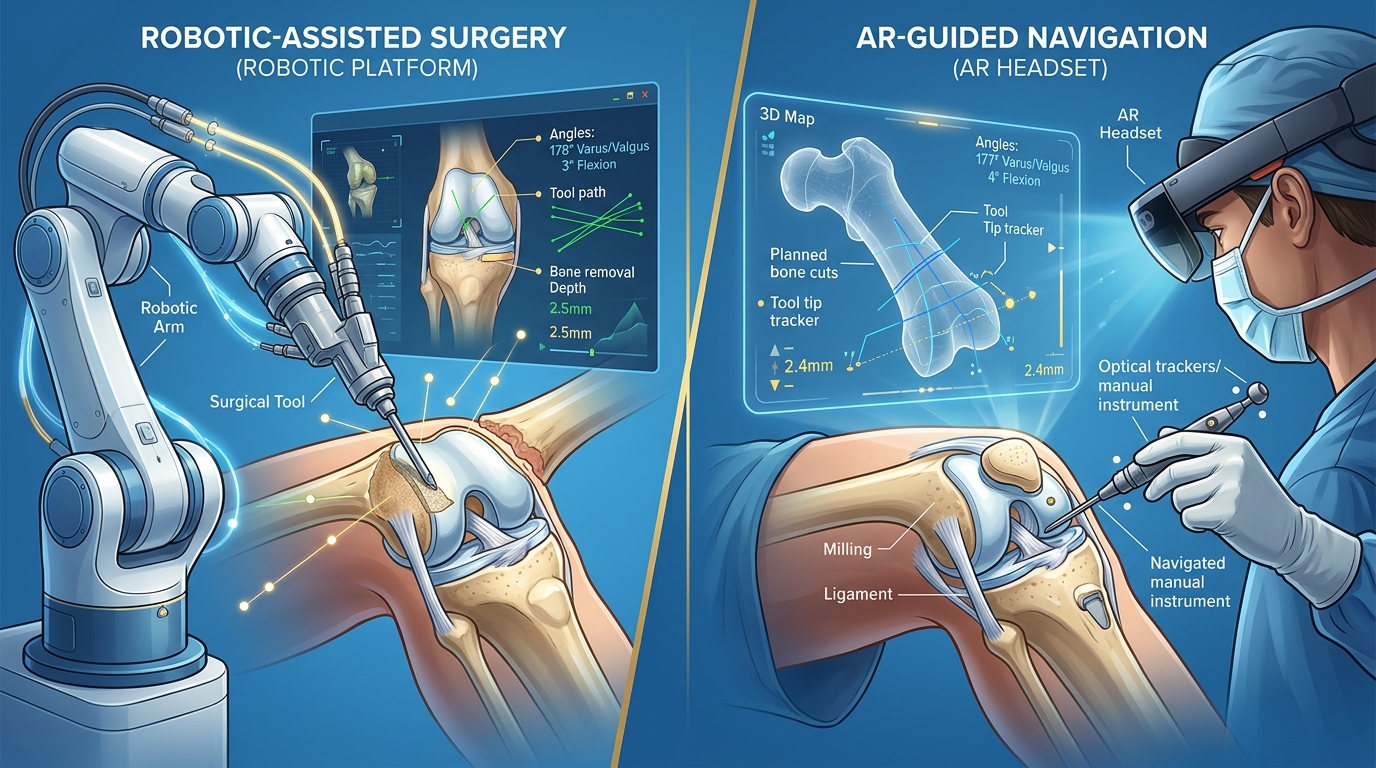
Core Takeaway: The important clinical decision is not which brand of technology is used, but whether partial knee resurfacing is genuinely the right operation for your specific arthritis pattern.
- Knee resurfacing is partial knee replacement (unicompartmental knee replacement / UKR), preserving healthy bone, cartilage, and both cruciate ligaments.
- FT3D is a centre-specific workflow and brand name, not an internationally recognised regulatory implant classification.
- AR navigation displays visual guidance while bone cuts remain manual; true robotic platforms physically assist or constrain tool execution.
- Imageless systems like CORI map the joint during surgery without requiring a pre-operative CT scan, saving radiation and cost.
- Patient selection dictates success: single-compartment arthritis with intact ligaments thrives, while multi-compartment wear requires total knee replacement.
Patients increasingly arrive having read about “knee resurfacing”, “FT3D” and “RoboLens”. These are reasonable things to ask about. This article explains, without promotion, what each term means, how the technologies differ, and the questions worth asking before you agree to any knee operation.
The single most useful thing to understand is this: the important decision is not which brand of technology is used. It is whether the operation being proposed is the right operation for your knee.
What “knee resurfacing” actually means
Knee resurfacing is another name for partial knee replacement, known medically as unicompartmental knee replacement (UKR).
The knee has three compartments. In resurfacing, only the damaged compartment is resurfaced; healthy cartilage, bone and both cruciate ligaments are left untouched.
This is a well-established operation. It has been performed for decades and has good long-term data behind it. It is not a new category of surgery, and no brand name changes what the operation fundamentally is.
When the word “resurfacing” is used in marketing, it is describing partial knee replacement. The meaningful question is not whether resurfacing sounds gentler than replacement — it is whether your arthritis is confined to one compartment.
What FT3D means
FT3D is a brand name used by a particular centre for its three-dimensional planning approach to knee resurfacing.
It is worth knowing that published descriptions of the acronym are not consistent: it has been described in different places as Fluoroscopy-Tracked Three-Dimensional and as Fast Track Three-Dimensional.
That inconsistency matters only insofar as it tells you what the term is: a name for a technique and workflow at a specific centre, rather than an internationally recognised device classification with its own regulatory clearance. The operation underneath it is partial knee replacement.
Augmented reality is not the same thing as a robot
This is the distinction most patients are never told, and it is the one that actually matters technically.
Augmented-reality navigation projects digital guidance into the surgeon’s field of view — typically through a headset such as Microsoft HoloLens. It shows the surgeon information. The bone cuts are still made by hand using conventional instruments.
A robotic platform goes a step further: the robotic instrument itself assists in, constrains or executes the bone preparation, so the physical execution follows the digital plan mechanically rather than relying on the surgeon’s hand alone.
Both can improve accuracy. Both are legitimate. But they are different categories of technology, and you are entitled to know which one is being used on your knee.
| Technology | What it does | Who makes the cut | Examples |
|---|---|---|---|
| AR Navigation | Displays a digital overlay or guidance to the surgeon | Surgeon, by hand, with conventional instruments | Headset-based AR guidance systems (such as RoboLens / HoloLens) |
| Robotic Platform | Physically assists or constrains bone preparation instrument | Surgeon, using a robotically controlled tool | CORI (Smith & Nephew), Mako (Stryker), ROSA (Zimmer Biomet), VELYS (DePuy Synthes), OMNIbotics (Corin) |
A note on CT scans
Some marketing presents “no pre-operative CT scan” as a unique advantage. It is not.
CT-based platforms such as Mako do require a planning CT, but imageless systems — including CORI, the platform used at NHS Ortho Robotics — map the joint surface during surgery and need no pre-operative CT at all.
Avoiding a CT is a property of imageless systems generally, not of any single brand.
Who is genuinely suitable for knee resurfacing
Partial knee resurfacing performs very well — in the right patient.
You may be suitable if:
- Arthritis is confined to one compartment, most commonly the inner (medial) side
- Your ligaments, particularly the ACL, are intact and functional
- Any deformity is mild and correctable
- You have a good range of movement
- Your pain is localised to one side of the knee rather than diffuse
Resurfacing is not appropriate when:
- Arthritis involves more than one compartment
- There is meaningful ligament instability
- There is significant deformity or stiffness
- The underlying problem is inflammatory arthritis, such as rheumatoid disease
- Pain is diffuse and cannot be localised to one compartment
A partial knee replacement performed in the wrong patient can fail early and require conversion to a total knee replacement.
A well-chosen total knee replacement will outperform a poorly chosen partial knee replacement every time. Patient selection matters more than the technology used.
Five questions worth asking any surgeon
Before you agree to knee resurfacing, ask your surgeon these five questions:
How we approach this at NHS Ortho Robotics
We perform both partial and total knee replacement using the CORI robotic platform from Smith & Nephew — an imageless, regulator-cleared robotic system requiring no pre-operative CT scan.
Our centre is among the first 50 CORI robotic knee centres worldwide, and Dr. Aggarwal serves as an International Robotic Instructor at the Smith & Nephew Academy in Singapore.
Under our ERAS (Enhanced Recovery After Surgery) pathway with aggressive early rehabilitation:
- Most knee replacement patients stand and walk with support within 3 hours of surgery
- Patients are discharged at around 48 hours for a single knee, or 72 hours when both knees are replaced in one sitting
- Hip replacement patients typically walk the following morning and go home at 48 hours
We also decline to operate when surgery is not yet warranted. A significant proportion of patients who send us their X-rays are advised on non-surgical management instead. That is not a marketing position; it is simply how the practice runs.
Frequently Asked Questions
What is knee resurfacing?
Knee resurfacing is another term for partial knee replacement, also called unicompartmental knee replacement. Only the damaged compartment is resurfaced; healthy cartilage, bone and ligaments are preserved. It is an established operation suitable only for patients whose arthritis is confined to one compartment.
What does FT3D knee resurfacing mean?
FT3D is a brand name used by a specific centre for its three-dimensional planning approach to knee resurfacing. Published descriptions of the acronym differ — it has been described both as Fluoroscopy-Tracked Three-Dimensional and as Fast Track Three-Dimensional. It names a technique and workflow rather than an internationally recognised device classification. The operation underneath is partial knee replacement.
Is RoboLens a surgical robot?
Published descriptions state that RoboLens uses Microsoft HoloLens-powered augmented reality with AI-assisted planning. That is augmented-reality navigation, which displays guidance in the surgeon's field of view, rather than a robotic platform in which a robotic instrument physically assists in preparing the bone. Both can improve accuracy, but they are different categories of technology.
Is knee resurfacing better than total knee replacement?
Neither is better in general — each is better for a particular patient. Resurfacing offers faster recovery and a more natural-feeling knee when arthritis is genuinely confined to one compartment and the ligaments are intact. Where arthritis is more widespread, or there is instability, deformity, stiffness or inflammatory arthritis, total knee replacement is the more reliable operation.
Do I need a CT scan before robotic knee surgery?
Not with every system. Image-based platforms such as Mako require a planning CT. Imageless systems such as CORI map the joint during surgery and need no pre-operative CT, avoiding the extra cost and radiation. Avoiding a CT is therefore not unique to any one brand.
How soon can you walk after robotic knee replacement?
This varies by centre and protocol. At NHS Ortho Robotics, Jalandhar, under an ERAS pathway with aggressive early rehabilitation, most knee replacement patients stand and walk with support within 3 hours of surgery, with discharge at around 48 hours for a single knee and 72 hours for both knees replaced together. Ask any centre for its own documented figures.
Can a partial knee replacement be converted later if arthritis spreads?
Yes. If arthritis progresses into the remaining compartments, a partial knee replacement can be revised to a total knee replacement. This is a more involved operation than a primary total knee replacement, which is precisely why correct patient selection at the outset matters so much.
Not Sure Which Operation You Actually Need?
Send your knee X-rays on WhatsApp. Dr. Aggarwal reviews them personally and will tell you honestly whether you need surgery at all, and if so, which operation genuinely fits your knee. No charge, no obligation.
WhatsApp your X-rays Call: +91 98142 09405 Visit: NHS Hospital, JalandharCorrect diagnosis | Clear guidance | Right decision